
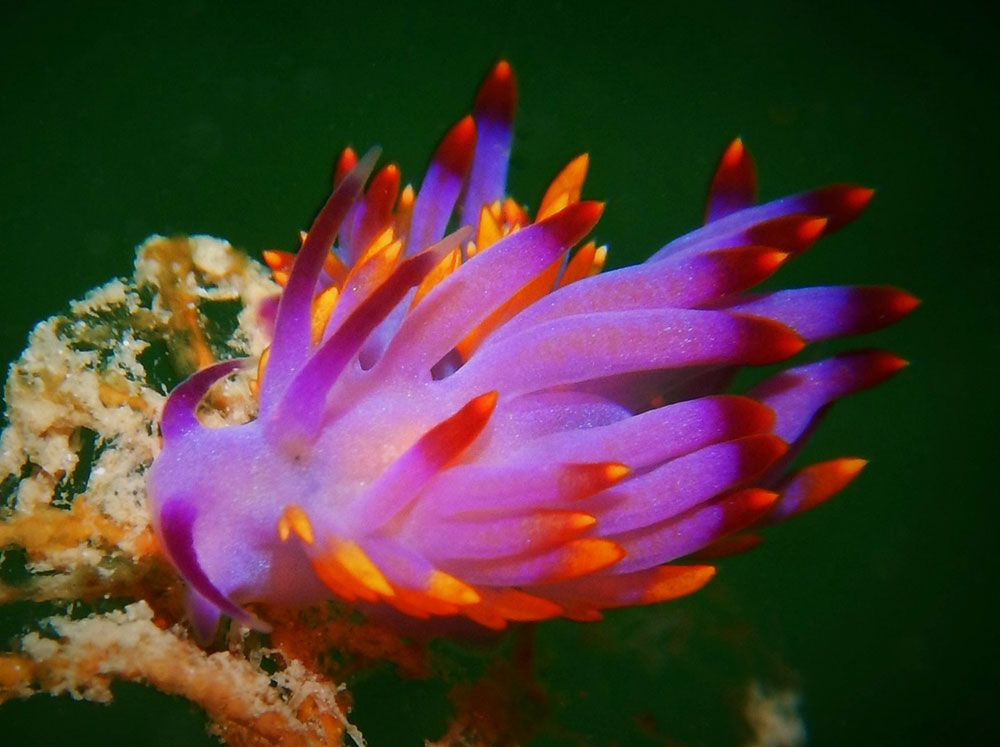
The word nudibranch pronounced ‘noo-dee-brank’, is Latin and literally means ‘naked gills’. This name refers to the circle of frilly exposed gills on the back of many species.
Featured image: Flabellina sp. Photographed by Natalie Callanan at Eaglehawk Island, Dampier Archipelago, WA
What is a nudibranch or sea slug?
They are brightly coloured, slow-moving, sea slugs who gracefully move through our ocean environments. Whilst the term ‘sea slug’ doesn’t sound too inviting, they are renowned for their variety, vibrant colours/patterns and beauty.
What do they look like?
Nudibranchs are gastropod molluscs with more than 3,000 species worldwide. In their larval stages, most species are planktonic with tentacles on their heads that act as sensory organs and are sensitive to touch, taste, and smell.
As adults, they look like colourful snails without a shell. Depending on species they have varied body shapes, ranging from a few millimetres to 60cm long.
All sea slug species have small, simple eyes set into their bodies that do little more than discern various levels of light.
Habitat – where do they live?
Most species live in temperate and tropical seas. They can often be seen crawling around on the seafloor or on the substrate of coral reefs rather than swimming in the water column. One recently discovered species was found at a depth of 2,500m and some live in the coldest oceans of Antarctica and the Artic.
In Western Australian waters, hundreds of species of nudibranchs have been identified. Many of these species are often spotted on our dives in the warm tropical waters of the Pilbara. Personally, I have counted up to 13 species in one dive with Chromodoris westraliensis being among them.

Chromodoris westraliensis photographed by Natalie Callanan at Legendre Island, Dampier Archipelago, WA
What do they eat?
Most species have tongue-like organ called a radula and a simple gut.
They are carnivorous, meaning they only feed on other animals. They are fussy and depending on the species, often feed on a specific species of prey. For example, some species only feed on mollusc eggs and others on a particular species of sponge.
Dermatobranchus ornatus photographed at the Mackerel Islands, Western Australia
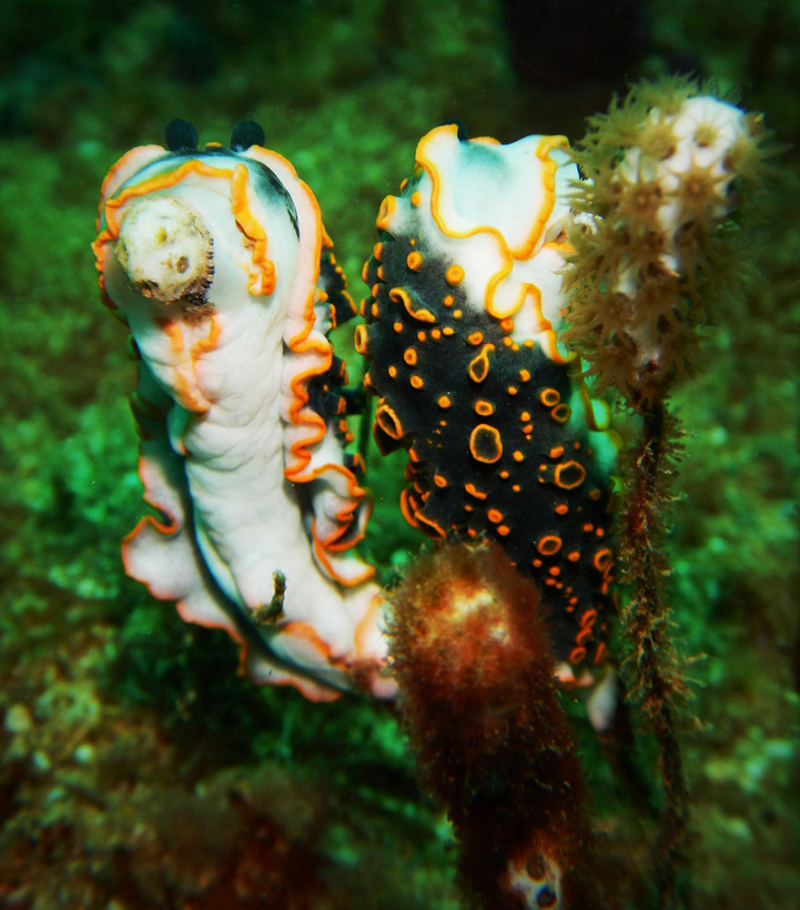
Photographed by Natalie Callanan, Mackerel Islands, WA.
How do they protect themselves?
As Nudibranchs have no shells for protection, they have developed alternative defences. Some species produce a distasteful noxious secretion to deter potential predators, such as fish. Other species feed on sea anemones, hydroids, jellyfish, soft and hard corals, storing special stinging cells called nematocysts from these animals. When attacked, they discharge the stinging cells to deter their predators. Others use camouflage to avoid detection and many have vivid colour patterns to advertise to predators that they are dangerous to eat.
There is still much to learn about nudibranchs and how they contribute to the ecosystem. Some species chemical defences and other compounds are being used in scientific research including cancer research.
How do they breed?
All are hermaphrodites, meaning they have both male and female sex organs. These organs are located on the right side of their bodies.
Being unable to self-fertilize, two nudibranchs will cross-fertilize each other by injecting sperm into each other via a penis. Eggs are usually laid in a coiled mass on an underwater surface. Some species emerge from the egg as crawling juvenile with most emerging as free-swimming larvae with a tiny remnant shell.
Egg numbers vary between sea slug species. Species such as Vayssierea felis can lay just one egg while Aplysia fasciata may lay more than 25 million eggs. And again, depending on species, lifespans range from a few weeks to a year with most species living for several months.
Photographed by Natalie Callanan, Dampier Archipelago, WA
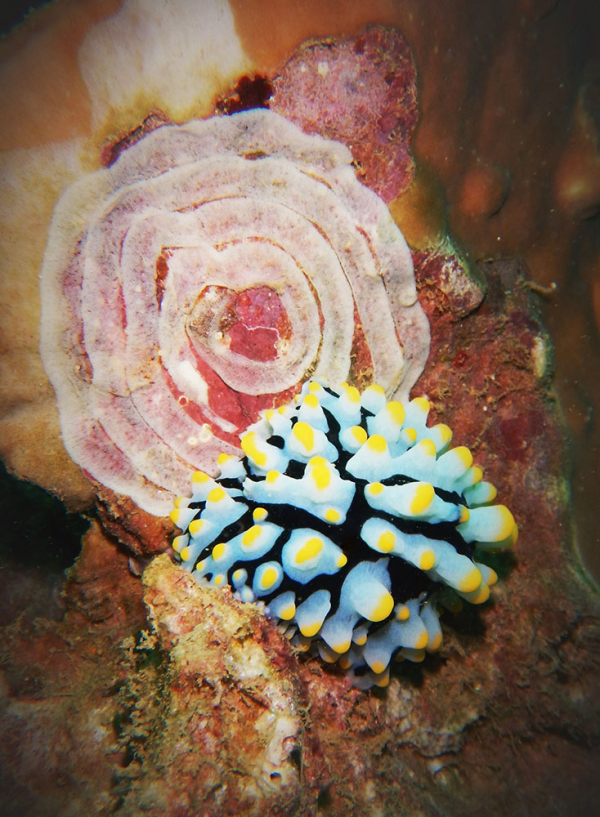
Photographed by Natalie Callanan, Dampier Archipelago, WA
How you can protect them?
Nudibranchs are slow moving creatures and can’t make a quick escape. So, whether you see them while diving, snorkelling or while exploring rock pools, look, take photos and look but don’t touch these soft-bodied animals.